Knocknaree archaeological dig
In the WoodsKnocknaree archaeological dig is a working excavation within a landscape marked for a new motorway, but its importance extends beyond the development dispute: as the investigation advances there, the surrounding Knocknaree wood becomes inseparable from Rob Ryan’s lost childhood and the memories that return, briefly and painfully, during the case.
Setting and mapped landscape
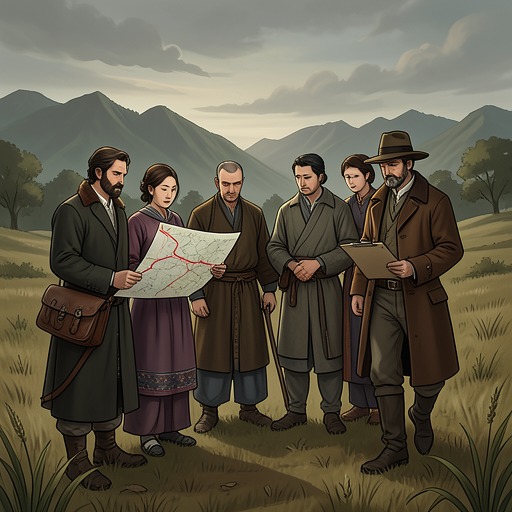
Sam’s large, painstakingly drawn map places the dig within a broader portrait of Knocknaree: houses, hills, a river, the wood, and a keep appear in fine pen-and-ink detail. Irregular colored blocks overlay the landscape, each marked with abbreviations and notes. The map gives a local, intimate scale to a place also subject to council decisions, property dealings, and infrastructure planning; its tiny drawn features make the proposed transformation harder to regard as an abstraction.
Two parallel dashed lines curve across the map, cutting through both the wood and the dig. They mark the route of the proposed motorway. The excavation is therefore not simply a backdrop to the investigation: it lies directly in the path of a project that would divide and alter the landscape around it.
Excavation and development pressure
The government announced the motorway plans in March 2000, then bought land from local farmers over the following year through compulsory purchase orders. Sam presents those transactions as formally regular, while Cassie Maddox questions whether that settles the matter. The distinction between an official process and its contested local consequences runs through the map: the route and property divisions are laid out clearly, but the fairness of the development remains unsettled.
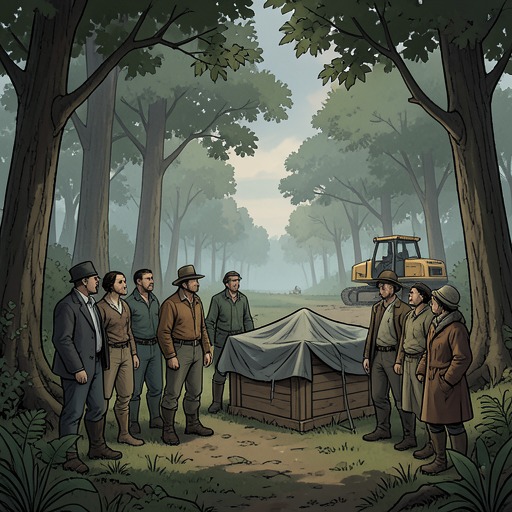
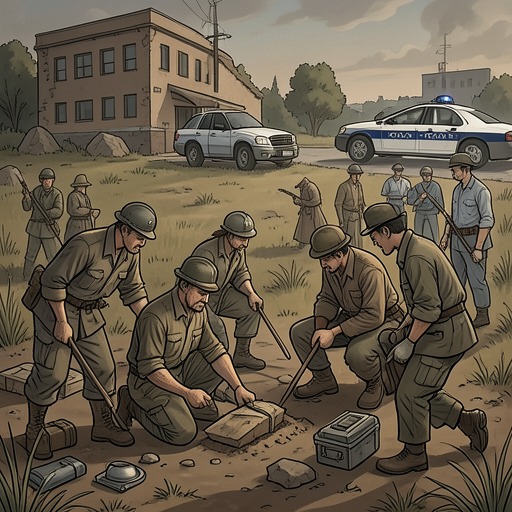
The excavation’s threatened position is made tangible by fieldwork. When Rob and Cassie park on the shoulder opposite the site, Mark, Mel, and other workers are using rods and yellow measuring tapes on the dig. Surveying equipment and the proposed route coexist in the same landscape: the site is at once a place being examined and ground already implicated in future construction.
The site within the investigation
Sam’s map becomes a central investigative aid after he has spent time interviewing county council members, surveyors, farmers, and members of Move the Motorway. His careful diagrams and coded annotations turn scattered inquiries into a visual account of land ownership and planning. The map is detailed enough to draw Rob and Cassie away from their review of door-to-door reports, shifting their attention from individual witnesses to the pattern of land transactions across Knocknaree.
The map also affects how Rob experiences the place. Its finely rendered leaves and stones seem almost too delicate for the pressure of development, and he finds himself imagining faces among the drawn trees. Cassie adds a caricature of a property developer, complete with horns and fangs, in one of the colored blocks. The comic gesture gives a visible, if private, shape to the suspicion and unease surrounding the land’s future.
Knocknaree and returning memory
For Rob, the investigation’s connection to Knocknaree carries a concealed personal risk. He knows he should tell O’Kelly that the case may touch the earlier disappearance he survived, but does not do so, aware that disclosure could remove him from the investigation and bring renewed questioning. As a child, he was repeatedly interviewed about what happened in the wood; he recalls the questioning only as distant voices against an imagined blank expanse of sky and grass. The site’s present significance is therefore bound to a history he cannot openly acknowledge to his colleagues.
During the investigation, Rob begins trying to recover what happened in the wood. He walks for hours through Dublin at night, sometimes coming to himself in unfamiliar places, and catches fragments of childhood: Peter and Jamie, family outings, and the sights and stories of Knocknaree. A later memory breaks through while he is half asleep, bringing back the three children witnessing Sandra Scully being assaulted in the wood. The recollection is intensely physical and frightening, but it does not make the past complete or dependable; it arrives as a fragment amid darkness and bodily panic.
After Operation Vestal, the recovered scenes disappear from Rob’s memory again. He can remember having remembered them, but they have become remote, like images from old films, and no longer feel as if they belong to him. In the end, only a single childhood image of Peter and Rob in a front garden remains. Knocknaree archaeological dig thus stands within a landscape whose physical future is contested and whose past, for Rob, repeatedly surfaces without becoming secure knowledge.